Your browser doesn't support the features required by impress.js, so you are presented with a simplified version of this presentation.
For the best experience please use the latest Firefox browser. Chrome probably works too
 Yelling into the VoIP
Internet! Because phones were too simple
- How humans hear
- How computers hear
- How to move voice between computers
- How to play audio

Goto src
(PSA: Careful when scanning untrusted QR codes!)
Goal: understand this E2E

Goal: understand this E2E have a reference for TLAs
Near end / Far end | RX/TX | Render / Capture

Inside a telephony app

Stages

Acoustics / Psychoacoustics
- Acoustics: how sound behaves
- Psychoacoustics: how humans think sound behaves
- Outside of computers: sound = variation in air pressure. A MECHANICAL process.
- When ploted (Pascals/Time), looks sinusoidal.
- Graphs here may or may not resemble actual audio.


Acoustics: Propagation

Acoustics: Reverb
Reverb gives humans sense of space

Echo
Reverb = aural event can't be sepparated. Echo = distinct aural events.

Noise

Stereo
Human use cues from reverb, stereo effects, absorption, etc to spatialize sounds and to create "audio focus".

Moving to capture / mic
Sound capture

Analogue to digital

Beamforming

Volume control: AGC/DRC

From DSP to user app

Other DSP types may include noise suppression, wind noise reduction, compensation for different hearing impairments, etc
We're here: capture
Let's discuss: render

Render: out of userspace

Render: out of DSP, into the world

Render sidequest: hearing range and Nyquist theorem


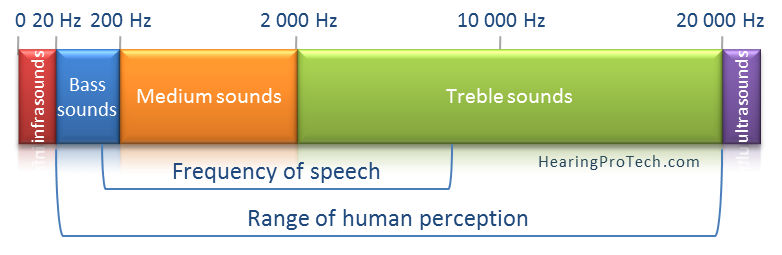
- Human hearing: 20 to 20KHz
- Human speech: 400 to 4KHz
- Sample rate 48KHz = Nyquist frequency 24KHz = Human hearing range
- Sample rate 8KHz = Less bandwidth, but not human hearing range
Transport

Audio -> Network packets

Frames -> Packets
- Packets may overlap frames
- [Lossy] compression
- Compression depends on available bandwidth
- Packets may be elided entirely depending on VAD (DTX)
Jitter buffering

Dealing with packet loss

Much better sources than this presentation
E2E pipeline

Bonus: Echo

Bonus: Echo

Bonus: Transfer function

The transfer function includes: time of flight between speaker and mic, reverb, different echo paths...
Bonus: AEC models multiple paths

Bonus: AEC reconverges when transfer changes


When the path changes, the AEC needs to recalculate the transfer function. This includes accounting for 3p DSP.